Why Is My Heat Pump Blowing Cold Air?
Quick answer
Cool air from a heat pump in heat mode usually falls into one of three situations:
- Cool for a short while, then warm again, and your home holds the temperature you set. This can be a normal defrost cycle, particularly in cool, damp weather. A fan set to ON, or the start of a heating cycle, can also make the air feel cool for a while. How long it lasts does not tell you the cause by itself, so check whether your home is holding its set temperature.
- Cool for a long time, and your home is not reaching the temperature you set. Something is keeping the system from heating properly. Try the safe checks below, then call a technician.
- A gas smell, a carbon monoxide alarm, smoke, sparks or fire. This is an emergency, not a heating problem. See the note below.
Gas smell, a carbon monoxide alarm, smoke, sparks or fire? Leave immediately and call 911 from outside. If you suspect a gas leak, do not operate the thermostat, lights, phone or other electrical controls on your way out. See the safety steps.
Electrical burning smell without smoke or sparks? Stop using the system, switching it off at the thermostat only if you can do so safely, and contact a qualified technician. See the burning-smell and breaker-trips guide.
A cool vent by itself does not mean a gas leak or carbon monoxide.
Is it actually a problem?
Heat pump air does not feel like furnace air. A furnace sends out short bursts of hot air. A heat pump sends out a steadier flow of warm air that can feel cool on your hand, even while it is heating your home.
Homeowners often describe exactly this: the thermostat shows the home at temperature, but the air from a vent near the bed or the couch feels like a cool draft.
So the better test is not how the air feels at the vent. It is whether your home reaches and holds the temperature you set. If it does, the system is probably doing its job.
Normal: the defrost cycle
In cold, damp weather, frost builds up on the outdoor unit. To clear it, the heat pump briefly reverses itself and warms the outdoor coil. While that happens, the air from your vents can feel cool.
What you may notice:
- Steam rising from the outdoor unit. It is water vapor from the melting frost. Smoke, sparks or fire are an emergency: leave and call 911 from outside.
- A whoosh or swoosh sound outside as the system changes direction.
- The outdoor fan stopping for a while.
- AUX or AUX HEAT on the thermostat, if your system has backup heat.
Defrost typically takes a few minutes. Manufacturers describe different timings for their own equipment, and it also depends on the weather, so there is no single number that fits every system.
It can happen even when it is above freezing outside, because the outdoor coil runs colder than the air around it.
Many systems turn on backup heat during defrost, so you may not feel any change. Not every system has backup heat. If yours does not, or if you have a dual-fuel system where the furnace does not run at the same time as the heat pump, you are more likely to feel cool air during defrost.
NEED A QUICK EXAMPLE? · OPTIONALSee what a defrost cycle looks like▶ Watch · 35 secHide video35 sec optional example▶ WatchHide video
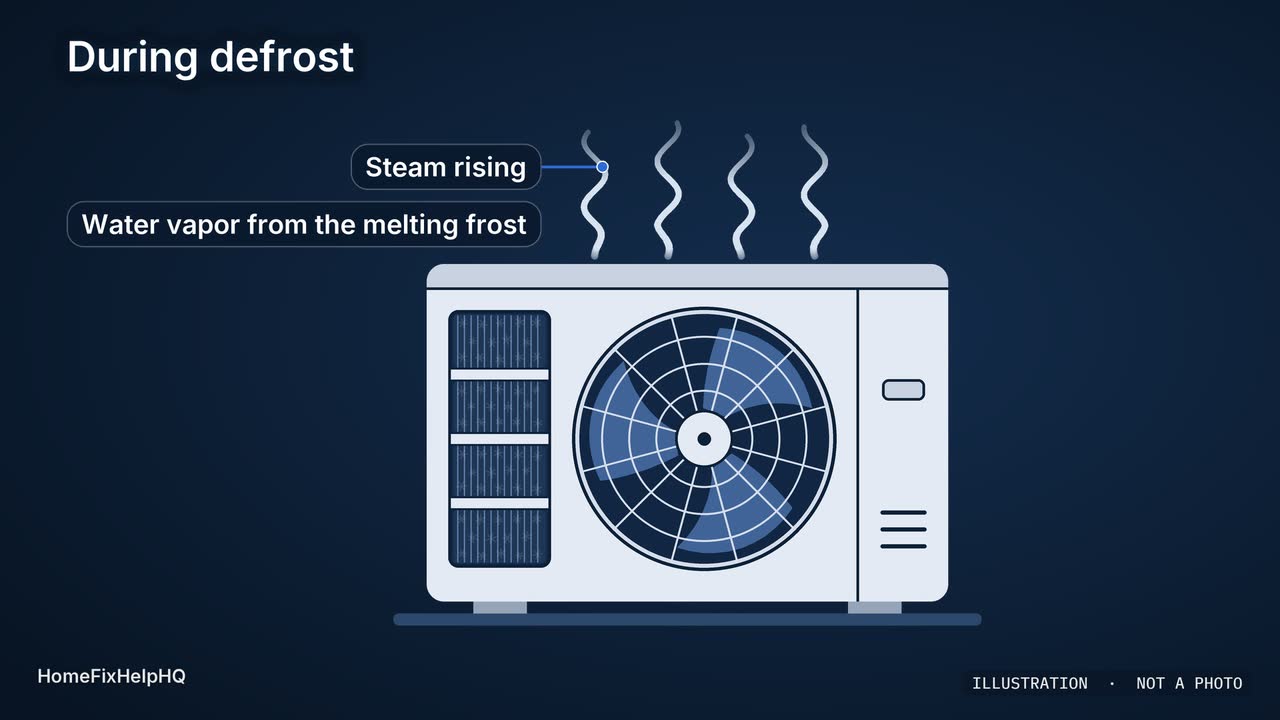
In cold, damp weather, frost builds up on a heat pump's outdoor unit. To clear it, the heat pump briefly reverses itself. That's a defrost cycle. During defrost, you may notice steam rising from the outdoor unit. It's water vapor from the melting frost. You may hear a whoosh outside, and the outdoor fan may stop for a while. Indoors, the air from your vents can feel cool. The key test is whether your home reaches, and holds, the temperature you set.
This video is optional. The written steps on this page are complete without it.
Safe checks you can do
These checks need no tools and no opening of the HVAC cabinet or any panel. A normal filter slot or return grille is not the cabinet. Stop at the first sign that a check is not possible without opening a panel.
Check 1: Thermostat. Make sure the mode is HEAT, not COOL. Make sure the set temperature is above the current room temperature. Set the fan to AUTO, not ON. With the fan on ON, air blows even when the system is not heating, and that air feels cool.
Check 2: Air filter. Before handling the filter, turn the thermostat to OFF. If the filter sits in a normal slot or grille that you can reach without opening the HVAC cabinet or removing a panel, look at it. If it is clogged, replace it with the right size and type, following the unit's instructions. If you cannot reach it that way, skip this step. Never run the system without the filter installed.
Check 3: Outdoor unit, by looking only. Look at the outdoor unit. Is it buried in snow or covered with leaves? If you can do it from safe, dry footing, clear loose snow and leaves from around it. Manufacturers generally ask for about two feet of open space around the unit; your model's manual has the exact figure.
If the checks do not help and your home is still not reaching the set temperature, call a technician.
What not to do
- Do not chip, pry, or break ice off the unit, and do not use sharp tools on it.
- Do not pour hot water on the unit or try to melt ice off it.
- Do not open panels or covers, and do not use the outdoor disconnect.
- Do not touch refrigerant lines or wiring.
- Do not keep resetting a breaker. A breaker that trips again means stop and call.
- Do not change installer settings on the thermostat or try to force a defrost.
- Do not go near the unit if the ground is icy, the area is wet, or you see exposed wiring.
Ice on the outdoor unit
A thin layer of frost on the outdoor unit can be normal in cold, damp weather. The defrost cycle is there to clear it.
Heavy ice is different. If heavy ice covers the outdoor coil, or ice does not clear after a normal defrost, contact an HVAC professional, even if your home still seems to hold its temperature. If you can do it safely, switch the system off at the thermostat. Never chip, melt or pull off ice that is stuck to the unit. Your model's manual takes priority over general guidance.
NEED A QUICK EXAMPLE? · OPTIONALSee thin frost versus heavy ice▶ Watch · 33 secHide video33 sec optional example▶ WatchHide video
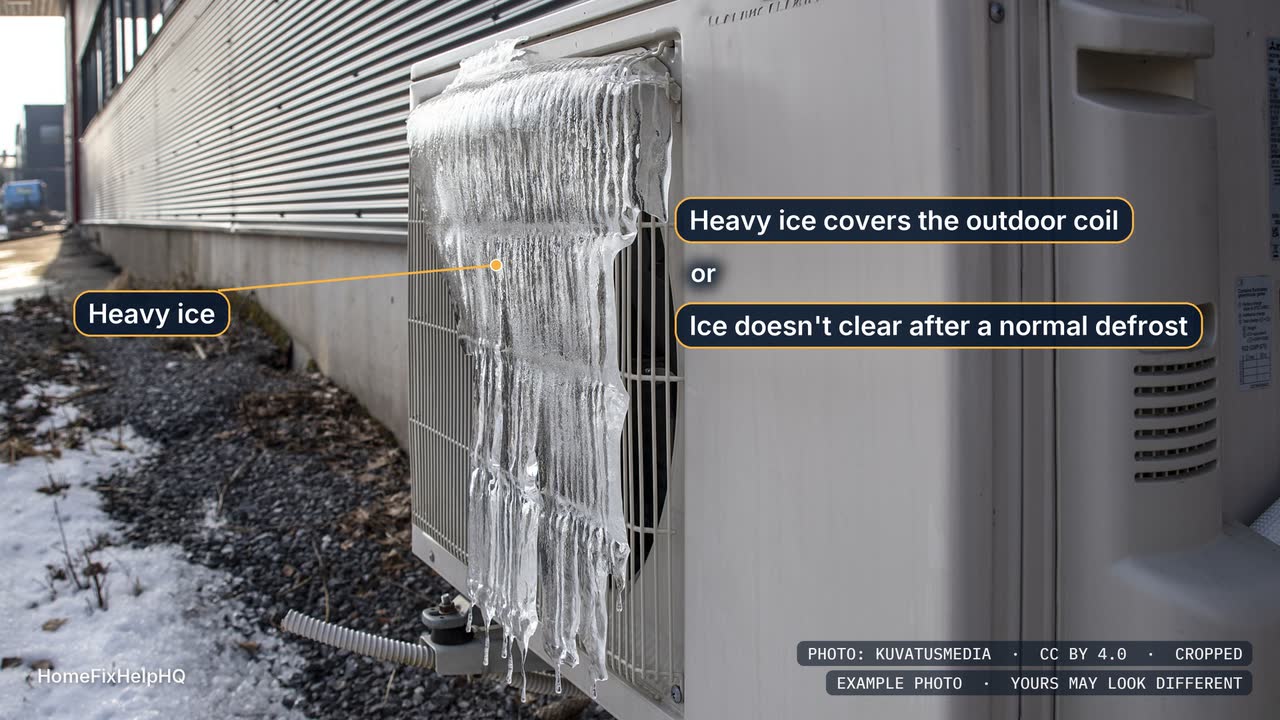
A thin layer of frost on a heat pump's outdoor unit can be normal in cold, damp weather. The defrost cycle is there to clear it. Heavy ice is different. If heavy ice covers the outdoor coil, or ice doesn't clear after a normal defrost, contact an HVAC professional. If you can do it safely, switch the system off at the thermostat. Never chip, melt, or pull off ice that's stuck to the unit.
This video is optional. The written steps on this page are complete without it.
AUX and emergency heat: what they mean
AUX indicates a supplemental or backup heating source. Depending on the system, that source may run alongside the heat pump or heat the home instead of it; in a dual-fuel system the backup can be a furnace.
In very cold weather, AUX may come on more often. If its operation is unusual for your system, or your home cannot stay comfortable, ask a technician.
Emergency heat (EM HEAT) is a thermostat setting that shuts the heat pump down and runs the home on the backup source alone. Electric backup heat uses more energy than the heat pump. With a furnace as the backup, the cost depends on your fuel and electricity prices.
Systems differ, so this guide does not tell you to switch to emergency heat. Check your system's manual, or ask your HVAC company whether and when it applies to your home.
A note on ductless mini-splits
Ductless systems also defrost, but they can behave differently from ducted systems. During defrost the indoor unit may pause, slow its fan, or give off some cool air. Filter and fan instructions for ducted systems may not apply to yours. Follow your model's manual.
When to call a technician
- Cool air continues after the safe checks.
- Your home does not reach the temperature you set.
- Cool air goes on for a long time, even in a new system. Do not assume a long episode is defrost.
- Defrost seems to happen constantly, or keeps getting longer.
- Heavy ice covers the outdoor unit, or ice does not clear, even if the home is still warm.
- You hear grinding, squealing, or banging.
- The thermostat shows an error code or warning.
- A breaker trips again.
- Backup or emergency heat seems to be carrying the home, and the home is still not comfortable.
Refrigerant problems and reversing-valve problems are not homeowner repairs. They need a licensed technician.
Emergency signs need the safety steps instead.
This is the site's existing Design B form in its inactive state. No service request can be submitted here. You can still review what to tell a technician and continue reading the guide.
What to tell the technician
- When the cool air happens, and for how long.
- Roughly how cold and how damp it is outside when it happens.
- What the thermostat shows: HEAT, AUX, EM HEAT, defrost, or an error code.
- Whether you saw steam, frost, or heavy ice on the outdoor unit.
- Whether the home reaches the set temperature.
- When the filter was last changed.
Heat pump or furnace?
Not sure which system you have? An outdoor unit alone does not tell you, because air conditioners have one too. See Furnace or heat pump? in our furnace guide.
Frequently asked questions
My home reaches the set temperature, but the air from the vents feels cold. Is something wrong?
Usually not. Heat pump air is not as hot as furnace air and can feel like a cool draft on your skin while it still heats the home. If the home holds the temperature you set, that is the sign that matters.
Why is my heat pump blowing cold air in heat mode?
It can be a defrost cycle. It can also be a thermostat set to COOL, a fan set to ON, a clogged filter, or a blocked outdoor unit. If it continues and the home is not warming, call a technician.
How long does a defrost cycle last?
Typically a few minutes, and it varies by manufacturer, model, and weather. If cool air goes on for a long time, or defrost seems constant, have the system checked rather than waiting it out.
AUX is showing and the air feels cool. Is that normal?
It can be. AUX often shows during defrost and in very cold weather. If the home stays comfortable, it is usually part of normal operation. If the home cannot keep up, call a technician.
Why is steam coming from my outdoor unit?
During defrost, melting frost can rise as water vapor. Manufacturers describe this as normal. Smoke, sparks or fire are an emergency: leave and call 911 from outside.
Should I switch to emergency heat?
That depends on your system. Emergency heat runs the home on the backup source alone. Check your manual or ask your HVAC company before using it.
Can I remove ice from my heat pump?
No. Do not chip it, pry it, or pour hot water on it. You can clear loose snow and leaves around the unit from safe footing. For heavy ice, or ice that does not clear, contact an HVAC professional.