Why Is My Furnace Blowing Cold Air?
Cool air from a furnace is not always a failure. It can be room-temperature air moved by a fan that is set to run all the time, a short cooler stretch while a cycle starts, or the blower finishing a cycle. It becomes a concern when the air stays cool and the house does not reach the temperature you set, when it blows warm and then cold again and again, or when the furnace keeps failing to start. This guide is for gas and oil forced-air furnaces. If your system includes a heat pump, see the heat pump section below.
Immediate danger: a carbon monoxide alarm, a gas smell, smoke, sparks or fire? Go to the safety steps first, before any troubleshooting.
Quick safety check
CO alarm, gas smell, smoke, sparks or fire? Leave immediately and call 911 from outside (for a gas smell, you can also call your gas utility). Electrical burning odor without smoke? Stop using the system and contact a qualified technician.
What cold air from a furnace can mean
From the vent, three situations can feel alike: the fan is running but the burners are not on; the burners have just started and the system has not warmed up yet; or the burners started and then stopped while the fan kept going.
Normal, or a warning sign?
| What you notice | Can be normal? | What to do |
|---|---|---|
| Fan set to ON, air feels cool between heat cycles | Often | Set the fan to AUTO and see if the cool air stops |
| Cooler air for a short time as the heat starts | Sometimes | Some furnaces hold the blower back while parts warm up; the delay varies by model — the owner's manual describes yours |
| Fan keeps running after the burners stop, and the room already reached the thermostat setting | Often | Leftover heat is moved through the ducts; how long depends on the model |
| The house stays below the setting and the air never warms | No | Do checks 1 and 2, then call a professional |
| Warm, then cold, repeating before the room reaches the setting | No | Check 2, then call; do not keep resetting |
| The furnace tries to start repeatedly, a light blinks, or it will not stay on | No | Write down what you see, then call |
| Fan runs even when the thermostat is off | No | See the FAQ |
We do not give a minutes-based rule for "too long": it depends on the model and conditions, and the table separates "the room already reached the setting" from "the room is not getting warm".
Sources: Carrier: furnace blowing cold air · Lennox: furnace blowing cold air · Trane: furnace blower
Safe checks you can do
Two checks that need no tools and no opening of equipment. Stop at the first sign that a check is not possible without opening a panel.
Check 1 — Thermostat mode, setting and fan
Set the mode to HEAT and the setting several degrees above the room temperature. Set the fan to AUTO. If the display is blank or weak and the thermostat uses batteries, replace them. If this started after a thermostat or equipment change, tell the technician; do not change wiring or installer settings yourself.
NEED A QUICK EXAMPLE? · OPTIONALSee what the fan setting does▶ Watch · 32 secHide video32 sec optional example▶ WatchHide video
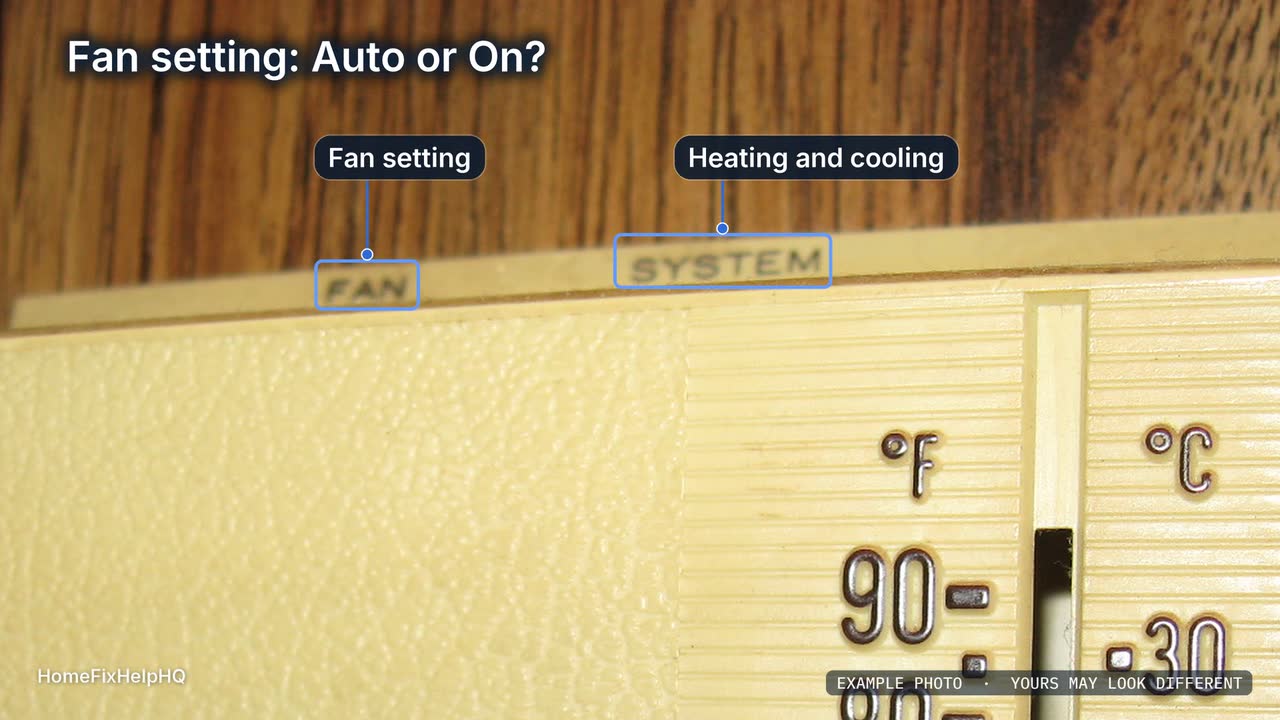
Your thermostat's fan setting is separate from heating and cooling. Set to Auto, the fan runs only while the system is actively heating or cooling. Set to On, the fan runs all the time, whether or not the system is heating or cooling. So in heating season, that air can feel cool. And in summer, it can seem like the AC never stops. Check the fan setting, and switch it to Auto if On isn't what you intended.
This video is optional. The written steps on this page are complete without it.
Check 2 — Filter and open airflow
Turn the thermostat to OFF. If your filter is in a slot or grille you can reach without removing any furnace panel or opening the cabinet, look at it. If it is clogged, replace it with the right size and type for your system, following the furnace and filter instructions. If you cannot reach it that way, skip this step and go to "When to call". Never run the furnace without a filter. Open supply registers and clear return grilles of furniture, rugs and curtains. A restricted filter or blocked airflow can make a furnace overheat, and a safety control can then stop the burners while the fan keeps running.
See also: the air filter guide.
Sources: Trane: furnace not blowing hot air · Carrier: furnace blowing cold air · Bryant: blowing cold air
When to call a technician
If the furnace still does not warm the house after the two safe checks, or it repeatedly starts and stops, arrange qualified HVAC service. Note what you observed for the technician. Emergency signs require the safety steps instead.
This is the site's existing Design B form in its inactive state. No service request can be submitted here. You can still review what to tell a technician and continue reading the guide.
Why a furnace may heat briefly and then blow cold
These are possibilities, not tests. A technician sorts them out. They are not things to try yourself.
Airflow and overheating
Filter, closed or blocked vents, return restrictions or duct problems can trigger a safety limit.
Flame sensing or ignition
If the furnace cannot confirm a steady flame, it shuts the burners off.
Controls and lockout
After repeated failed starts a furnace can lock out, and control-board faults are a service matter.
High-efficiency furnaces — condensate drain
A blocked drain can stop the burners on these models.
We do not rank these by how common they are because no source we reviewed measures that.
Sources: Trane: furnace not blowing hot air · Carrier: furnace blowing cold air · Lennox: furnace blowing cold air · Trane: furnace blower
If the fan runs but the heat does not come on
Do not open the furnace. Do checks 1 and 2 as above. If you use oil or propane, check the tank level. If you already know your gas service was interrupted, tell the technician. If heat does not return, contact a qualified HVAC technician.
What not to do
Do not relight a pilot or open the burner compartment; clean, bend or remove a flame sensor; touch gas valves or controls, switches inside the cabinet, vents or condensate parts; remove access panels; test wiring or voltage; bypass a safety switch; keep resetting the breaker or power; or run the furnace without a filter. Some manufacturers' own pages allow some of these for "comfortable" homeowners; this guide does not, because it cannot judge your equipment or your situation. Do not try to read what a code means from a general article — a technician has the model-specific information.
When to stop using the furnace and contact a professional
- The air stays cool and the house does not warm after checks 1 and 2.
- It starts, stops and tries again, or shuts off every few minutes.
- It has failed to start more than once, or a light or display shows a fault.
- Banging, rattling or squealing.
- A breaker keeps tripping — stop resetting it.
Have fuel-burning heating equipment checked by a qualified technician every year.
If the loss of heat puts anyone at risk — for example very cold temperatures, a baby, an older adult or someone with a health condition — do not wait it out: arrange safe temporary heat or seek appropriate urgent help.
Sources: Bryant: blowing cold air · CPSC carbon monoxide fact sheet · CPSC heating safety (2025)
While you wait: safe temporary heat
- Electric space heater: keep all sides at least 3 feet from beds, curtains, furniture and papers; plug it directly into a wall outlet, not a power strip; never leave it running unattended in a confined space; switch it off before sleeping.
- Never use a charcoal grill or a generator indoors or in a garage, and do not use a kitchen range or oven to heat the home.
- Keep CO alarms working. If one sounds, follow the safety steps above.
Sources: CPSC winter safety tips (2026) · CPSC heating safety (2025) · CPSC heating hazards (2005)
What to tell the technician
- Furnace type (gas or oil) and age if you know them
- Thermostat type and the mode and fan setting
- When the air feels cool (from the first minutes, or only after it was warm) and roughly how long heat runs
- Whether the room reaches the setting
- Any display, light or sound you can see or hear from outside the cabinet (write it down before any reset — do not decode it)
- The filter's condition
- Recent work, a thermostat change or a power outage
- The model label only if you can read it without opening anything
- Any CO alarm, odor, breaker trip or gas-service interruption
Furnace or heat pump?
This guide covers furnaces. Heat pumps work differently: during a defrost cycle the vents can feel cooler, mainly where there is no electric backup heat, or in a dual-fuel home where the furnace does not run alongside the heat pump. Manufacturers describe this as normal for a short time; call a professional if it keeps happening, gets longer, or ice stays on the outdoor unit. See our heat pump blowing cold air guide.
A home with a furnace can still have a heat pump (dual fuel). A visible outdoor unit does not tell you which, because air conditioners also have one. Clues: the thermostat shows AUX or backup heat, the installer's paperwork, or an equipment label you can read without opening anything. Do not change wiring or installer settings to find out. If you are unsure, ask your installer or HVAC company. See the heat pump and system-choice guides, and the short-cycling guide's defrost section.
Sources: Trane: heat pump defrost · Carrier: heat pump troubleshooting · ENERGY STAR heat pumps
Frequently asked questions
Short answers to the questions homeowners commonly ask about a furnace blowing cold air.
Why is my furnace blowing cold air when the thermostat is set to heat?
The fan may be set to ON, the burners may not have started yet, or they may have stopped while the fan kept running. Check that the mode is HEAT, the setting is above room temperature and the fan is on AUTO; if it stays cool, contact a qualified technician.
Why does my furnace blow warm air for a few minutes and then cold air?
The burners may be shutting off, for example on a safety control after restricted airflow, or when the furnace cannot confirm a flame. Check the filter (only if reachable without opening anything) and vents, and do not keep resetting it; if it repeats, call a technician.
Is it normal for a furnace fan to blow cool air after the heat turns off?
Often. The blower can run on after the burners stop; how long depends on the model. If the room does not reach the thermostat setting, it is not normal.
Can a dirty filter make a furnace blow cold air?
A clogged filter can restrict airflow, cause overheating and trigger a safety shutdown. Replace it per the manufacturer's instructions only if you can reach it without opening equipment, and never run without one.
Should I keep resetting a furnace that starts working again?
No. A restart is not a repair. Write down any light or display, then call a technician.
Why is the furnace fan running when the heat is off?
If the fan is set to ON it runs all the time; set it to AUTO and check thermostat batteries. If it keeps running with the thermostat off, call a technician.
How do I know if I have a furnace or a heat pump?
A visible outdoor unit does not settle it, since air conditioners have one too. A thermostat showing AUX or backup heat, the installer's paperwork, or a label you can read without opening anything can help; if unsure, ask your installer. Some homes have both (dual fuel).