AC won't turn off or keeps running? Start here.
First, work out which part is actually running. If air keeps blowing from the vents but the outdoor unit cycles on and off, check whether the thermostat fan is set to "On" instead of "Auto" -- on "On" the indoor blower runs continuously even when the system is not cooling. If the outdoor unit runs for hours on a very hot day, long runtime can be normal -- but only while the air from the vents stays cold and the house holds its temperature. If the outdoor unit keeps running after the thermostat is switched off, that is a different problem that needs qualified diagnosis. Compare the patterns below before deciding what to do next.
What could be keeping your AC running?
Pick the pattern that matches what you're seeing.
The system (or just the fan) runs nonstop, and the thermostat's fan setting is on "On" instead of "Auto"Most common
Air keeps blowing from the vents all the time, whether or not the house is actually being cooled -- often mistaken for the AC itself never stopping.
The thermostat's fan setting controls the indoor blower separately from the cooling system. On "Auto," the fan runs only while the system is actively heating or cooling. On "On," the fan runs continuously, all the time, whether or not the system is actually cooling.
- Check the thermostat's fan mode and switch it from "On" to "Auto" if that's not the setting you intended.
- Confirm the temperature setting is a few degrees above the current room temperature, not set unrealistically low.
- The fan is already on Auto, the setpoint is reasonable, and the outdoor unit itself still never stops -- see the branches below, this isn't a fan-setting problem.
NEED A QUICK EXAMPLE? · OPTIONALSee what the fan setting does▶ Watch · 32 secHide video32 sec optional example▶ WatchHide video
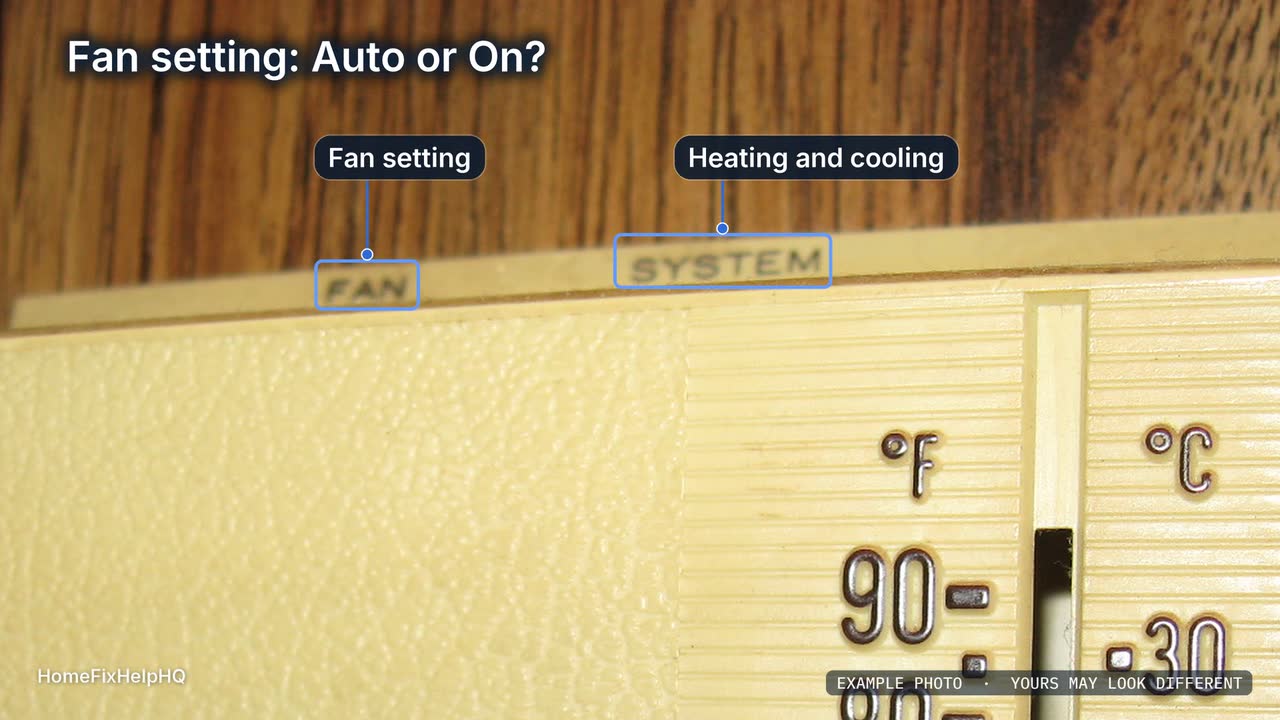
Your thermostat's fan setting is separate from heating and cooling. Set to Auto, the fan runs only while the system is actively heating or cooling. Set to On, the fan runs all the time, whether or not the system is heating or cooling. So in heating season, that air can feel cool. And in summer, it can seem like the AC never stops. Check the fan setting, and switch it to Auto if On isn't what you intended.
This video is optional. The written steps on this page are complete without it.
It's a very hot day, the air from the vents is cold, and the system just runs for hoursCan be normal
During a heat wave the outdoor unit and the indoor blower run almost continuously. The air from the vents is cold and the house is roughly holding the set temperature (or losing only a degree or two in the afternoon), but the system rarely or never shuts off.
Possibly none -- but only when all three conditions hold: the weather is genuinely extreme, the air from the vents is cold, and the house is holding its temperature. In mild weather a single-stage system typically runs in cycles; manufacturer troubleshooting pages describe runs of roughly 15–30 minutes, about two to three cycles per hour, and describe near-continuous running on the hottest days as normal for a system that is keeping up. Variable-speed and inverter systems are designed to run for long stretches at low speed rather than switching off. Continuous running in mild weather, or a house that keeps getting warmer while the system runs, points to a real problem.
- Confirm the thermostat is set to Cool with the fan on "Auto," and that the setpoint is realistic for the day rather than set far below the room temperature.
- Check and replace a dirty filter, and confirm supply and return vents are open.
- Note the indoor temperature over an hour or two: is the house holding steady, or losing ground?
- The indoor temperature keeps rising while the system runs, the air from the vents is not cold, or you see ice on the indoor coil or refrigerant line -- turn cooling off first and let it thaw (see Safety boundaries).
- The system runs continuously in mild weather after the filter and vent checks, or your electric bill has climbed sharply without a change in weather.
The outdoor unit keeps running with constant power, even after the thermostat is off or should be satisfiedNeeds a technician
The outdoor condenser/compressor keeps running even after you turn the thermostat off, or well past when it should have reached setpoint and stopped.
A stuck or welded-closed compressor contactor -- an electrical relay -- can keep sending power to the outdoor unit continuously, regardless of what the thermostat is telling it to do.
- From outside the unit only, note whether the outdoor unit keeps running even after switching the thermostat off. Give it a few minutes after changing the thermostat before you judge -- many systems have a built-in restart delay, and the outdoor unit may take a few minutes to respond.
- If it still keeps running with the thermostat off, leave the thermostat off, note what you observed, and call a technician -- this pattern is diagnosed and repaired by a licensed technician, not by homeowner troubleshooting.
- Do not open the outdoor unit's panel.
- Do not touch, tap, or otherwise try to free a contactor or any electrical component yourself -- it is a live electrical part.
- Do not repeatedly flip the breaker to try to force the system to reset.
- The outdoor unit keeps running with the thermostat off, or well after the setpoint should have been reached -- a licensed technician needs to inspect it and, if needed, replace the contactor.
- You notice a burning smell, smoke, or sparking near the unit -- stop and call immediately (see Safety section).
Airflow feels weak or restricted everywhere, and the system seems to run longer than it used toCommon
The system runs for long stretches and airflow feels weaker than normal system-wide, not just in one room.
A dirty air filter, or closed/blocked supply and return vents, can restrict airflow enough that the system takes longer to satisfy a cooling call.
- Check and replace the filter if it's dirty.
- Confirm supply and return vents are open and unobstructed.
- Clear visible leaves, debris, or vegetation from around the outdoor unit, without removing any panels.
- Airflow stays weak and the system still runs continuously after the filter and vents check out -- this may need a closer duct/return-sizing look (see the dedicated weak-airflow guide below) or a technician visit.
You've checked the filter and vents, it's still running long, and a coil looks dirtyNeeds a technician
Filter and vents check out, but the system still seems to run longer than expected, and a coil (indoor evaporator or outdoor condenser) looks visibly dirty or coated in debris.
A dirty evaporator coil reduces the system's ability to transfer heat efficiently, which can make it run longer to reach the same result.
- Visually note whether a coil looks dirty. Do not attempt to clean it yourself.
- Do not clean the evaporator coil yourself -- there is a risk of electrical shock, and coil fins are easily damaged.
- A coil appears dirty or coated -- professional cleaning is the safe next step.
Fan mode, filter, vents, and the outdoor unit all check out, and it's still running nonstopNeeds a technician
None of the checks above explain it -- the system still runs far longer than expected, or never seems to stop.
Two remaining possibilities: the thermostat's internal wiring or sensor has degraded over time and is no longer reading correctly, or the AC system itself is undersized for the home's cooling load.
- None beyond what's already been checked in the branches above -- this combination of symptoms needs a professional diagnosis.
- A technician can test the thermostat's wiring and readings.
- A qualified dealer can evaluate whether the system is correctly sized for the home.
Safety boundaries
These come directly from the sources below — not general caution language.
Ice on the indoor coil, the refrigerant lines or the outdoor unit: turn cooling off and let it thaw before any further checks -- running a frozen system can damage the compressor. Smoke, sparks or a burning smell: keep clear, stop using the system if you can do so safely, and get urgent help.
When to stop and call
You see smoke near the outdoor unit or anywhere in the system
You see sparking near the outdoor unit or electrical components
You smell burning near the outdoor unit or indoor equipment
You see ice on the indoor coil, the refrigerant lines, or the outdoor unit -- turn cooling off and let it thaw before any further checks; running a frozen system can damage the compressor. The AC freezing guide (linked under Related HVAC questions) covers the safe thaw sequence.
Frequently asked questions
My thermostat's fan is set to "On." Is that why my AC seems to run all the time?
Possibly. On the "On" setting, the indoor fan blows continuously whether or not the cooling system is actually running -- which can feel like the AC never stops even when the compressor itself is cycling normally. Switching the fan setting to "Auto" is the first thing to check.
Is it safe to try to fix a stuck contactor myself?
No. A stuck or welded contactor is a live electrical component, and it should only be inspected or replaced by a licensed technician. Do not open the outdoor unit's panel or attempt to tap, clean, or otherwise free a contactor yourself.
I checked the fan mode, filter, and vents, and it's still running nonstop. What's next?
At that point the remaining causes -- a degraded thermostat sensor/wiring, or a system that's undersized for the home -- both need a professional. A technician can test the thermostat directly, and a qualified dealer can evaluate whether the equipment is correctly sized.
Is it normal for my AC to run for a long time in hot weather?
It can be -- under specific conditions: genuinely hot weather, cold air from the vents, and a house that is holding its temperature. Manufacturer troubleshooting pages describe mild-weather cooling cycles of roughly 15–30 minutes, about two to three times an hour, and describe near-continuous running on the hottest days as normal for a system that is keeping up. Variable-speed and inverter systems are designed to run for long stretches. What is not normal: continuous running in mild weather, a house that keeps getting warmer, warm air from the vents, ice on the coil or lines, or an outdoor unit that keeps running after the thermostat is switched off.
My AC fan won't turn off, but the air isn't cold. What does that mean?
Most often the thermostat fan setting is on "On," which runs the indoor blower continuously whether or not the system is cooling, so you feel room-temperature air between cooling cycles. Switch the fan setting to "Auto" -- the setting manufacturers and the U.S. Department of Energy recommend for normal use -- and see whether the blower now stops between cycles. If the fan is already on Auto and the blower still never stops, or the air stays warm while the outdoor unit runs, use the branches above and the not-cooling guide.
My system is variable-speed or inverter-driven. Is it supposed to run all the time?
Largely, yes. Manufacturers of variable-speed and inverter systems describe them as designed to run longer, at lower speed, instead of switching fully off once the setpoint is reached -- on hot days they may run at full capacity for extended periods. Judge these systems by whether the house holds temperature and the air stays cold, not by runtime alone. If the house loses ground, the air is not cold, or the unit runs flat-out in mild weather, have it checked.